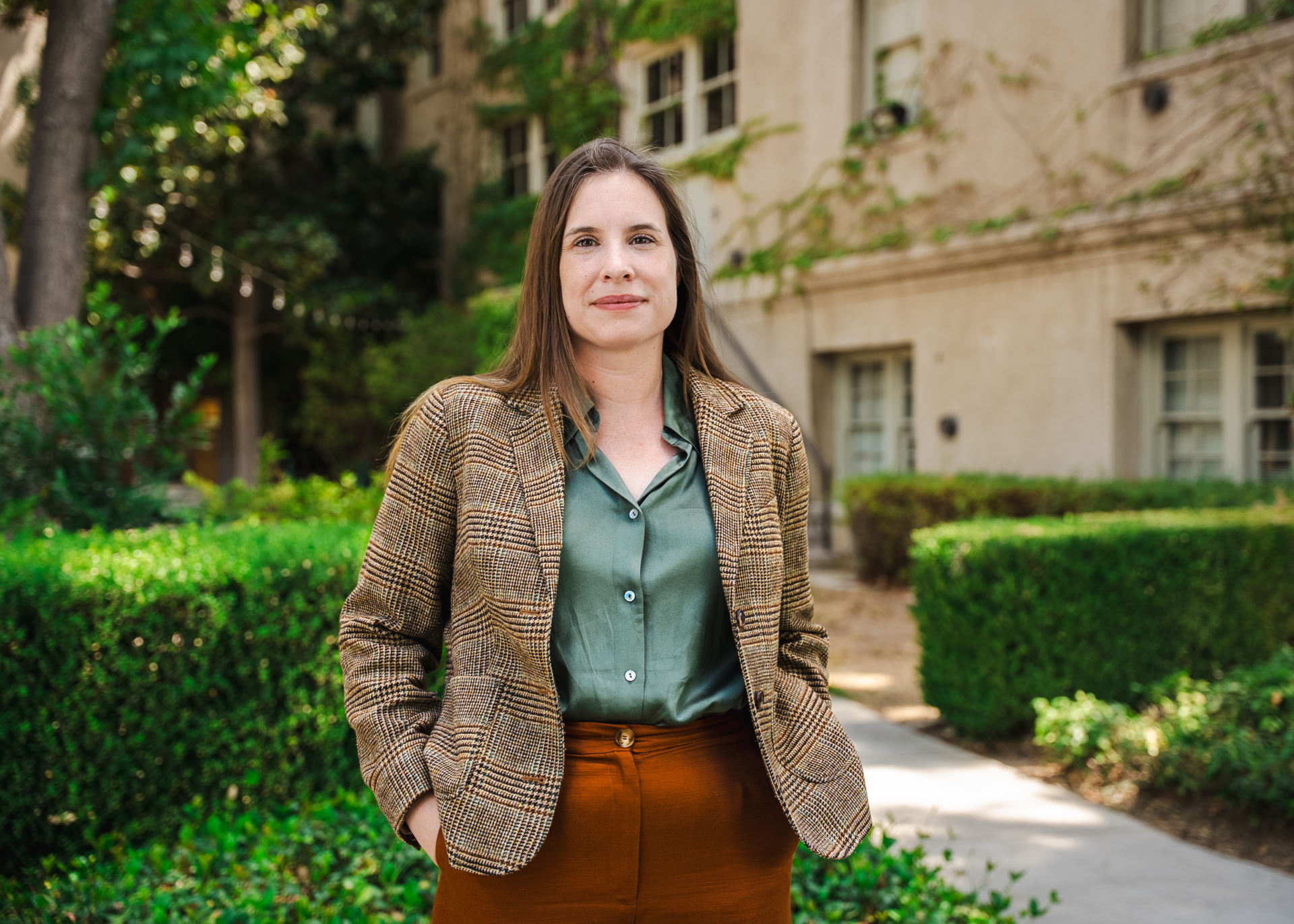
In Conversation: Global Lessons to the ULV Classroom
Dr. Lauren Crossland-Marr, assistant professor of Anthropology at the University of La Verne, has built her career on a deceptively simple idea: food is more than sustenance; it is a window into culture, politics, and identity. From studying halal certifications in Milan, Italy to examining how CRISPR, a gene-editing technology, is shaping modern agriculture, Dr. […]
January 21, 2026
Dr. Lauren Crossland-Marr, assistant professor of Anthropology at the University of La Verne, has built her career on a deceptively simple idea: food is more than sustenance; it is a window into culture, politics, and identity.
From studying halal certifications in Milan, Italy to examining how CRISPR, a gene-editing technology, is shaping modern agriculture, Dr. Crossland-Marr explores how what ends up on our plates reflects the systems and values that define our world.
Since joining the University of La Verne in 2024, Dr. Crossland-Marr has become known for her approachable yet thought-provoking teaching style. Her classes don’t just teach theory; they invite students, many of whom are first-generation or bicultural, to see how their own experiences connect to broader global issues. Whether she’s producing her podcast A CRISPR Bite, developing research on soybean farming in the Midwest, or finding creative ways to balance fieldwork with life as a mother, Dr. Crossland-Marr brings energy, curiosity, and care to everything she does.
In this conversation, she reflects on her path into anthropology, her passion for connecting science and culture, and how she hopes to inspire students to see their place in shaping the future of food and society.
What originally drew you to anthropology, and how did food systems become your lens for exploring culture and identity?
I’ve always been curious about why certain things feel “right or natural” based on where and how we grew up. Anthropology gave me tools to connect those everyday experiences to larger systems like power and inequality. When I was doing my PhD research in Italy, studying food certification in the food system, it became clear how much food carries questions of authenticity and belonging. For the Muslim communities I worked with, food wasn’t just about sustenance; it was about religious adherence, identity, and national belonging. That was my entry point into food anthropology.
You balance a demanding academic career, research, a podcast, and teaching—all while raising a family. How do you manage it all?
Some days I do, and some days I don’t! It took me a while to learn that rest is as much a part of productivity as output. I set aside time for writing, for my daughter, and for sleep. Having a strong support network of mentors, colleagues, and friends helps enormously. And curiosity is my biggest motivator, when I’m excited about a project, I somehow find the energy to make it work. But I’ll be honest, I’m no model of perfect balance.
What brought you to the University of La Verne, and what stood out when you joined the faculty?
ULV’s commitment to first-generation and nontraditional students really resonated with me. If education is going to be meaningful, it has to include everyone, not just those with a straight path to higher education. I was also drawn to the university’s emphasis on equity and social justice. From day one, I felt welcomed by my colleagues, and I’ve been inspired by our students. Many of them are bicultural and bring such rich, layered perspectives to our discussions about culture, politics, and identity.
Your podcast, A CRISPR Bite, blends storytelling with science. Why did you choose audio as your platform, and how did you push yourself to do it?
Honestly, I was nervous at first. I wanted to make complex questions about gene editing feel intimate and relevant. Audio felt like the perfect medium. You get to hear from farmers, scientists, and activists in their own voices. The podcast began as a pandemic project when my postdoctoral work at Dalhousie University transitioned from on-campus to remote. What started as a creative outlet soon evolved into a platform that connected with audiences far beyond academia.
How do you translate something as technical as CRISPR into something engaging for general audiences?
I start with people. Anthropology is about stories, so I frame the science around human experiences and what CRISPR means to the farmers or scientists who work with it. I avoid jargon, use metaphors, and test my scripts on friends and students to make sure it’s clear. If I can’t explain it as a story, I know I don’t understand it well enough yet.
You’ve voiced concerns about equity in food technology. How can CRISPR and other innovations better serve fairness?
The first step is asking who’s at the table when these technologies are being developed. Whose problems are they solving? Too often, the answer is corporations and startups, not small-scale farmers or marginalized communities. CRISPR can be part of the solution, but it can’t be the only solution. We also need policies that address land access, seed sovereignty, fair labor, and transparency about trade-offs. Innovation is never neutral—it reflects the systems and values behind it.
Where do you see the biggest gap in public understanding of food systems?
Most people think food choices are purely personal, without realizing how much policy and infrastructure shape access to healthy food. Anthropologists now prefer the term “food apartheid” over “food desert,” because these inequities were created through historical and systemic forces, not by chance. Another gap is the belief that technology alone can solve hunger or climate change. History shows us—like during the Irish potato famine—that these are political and economic problems first.
Your research has taken you from Milan to Halifax to Southern California. How has that shaped your perspective on global food politics?
It’s made me deeply skeptical of one-size-fits-all solutions. Every context is different, and local realities matter. At the same time, these places all raised similar questions, about authenticity, belonging, and what’s considered “natural.” Those connections help me bring a global, comparative lens into the classroom.
What do you find most rewarding about working with ULV students?
Seeing them realize what’s possible for their futures. After hosting Yale scholar Dr. Chelsey Carter for a guest talk, many students wrote to me about how powerful it was to see someone who looked like them succeeding in academia. Those moments remind me to amplify diverse voices and to help students see that their ambitions are achievable.
ULV emphasizes lifelong learning. What does that mean to you?
For me, it’s about staying curious and humble. I learn as much from my students as they do from me. They connect ideas in ways I wouldn’t think of, and they keep me engaged with the world outside academia, whether that’s exploring how to thoughtfully integrate AI into our classrooms or finding new cultural touchpoints for lessons. Lifelong learning is what keeps me energized and makes me love what I do.
What’s next for you? Another podcast, new fieldwork, or a book?
All three! I recently signed a book contract for Parma Ham and Halal Salami, an ethnography about food certification and belonging in Italy designed for introductory courses. I’m also starting fieldwork on soybeans in the Midwest, exploring how innovation and infrastructure shape farming, and developing a soybean-focused podcast. On campus, I’m building a teaching project using ULV’s Native Californian basketry collection to explore food systems. And, of course, I’m savoring every moment with my two-year-old, she keeps me grounded and inspired.